


What price should you charge when reselling stainless steel jewellery? Calculations and examples

Build a resale price list from actual costs, selling expenses and your sales channel. Fictional examples, clear formulas and answers for jewellery retailers.
What should you charge for a stainless steel bracelet, ring or necklace? Start with your costs, your sales channel and the service you provide. Multiplying the supplier price by an arbitrary number produces a quick figure, but can hide expenses. Copying another shop’s price without knowing how that business operates does not tell you whether your own activity will cover its costs.
This guide explains how to build a consistent price list, check a discount and monitor results. All amounts in the calculations are fictional: they illustrate a method and are neither current Saze Diffusion prices nor mandatory resale prices. Use your invoices, actual expenses and a consistent tax basis for your own decisions. The arithmetic is a starting point for managing your business, rather than a promise of profit or a substitute for understanding your costs.
Start with the jewellery cost, then include overlooked expenses
Record the amount actually paid
Write down the purchase cost for each reference after discounts you actually received. Keep the quantity and date so you can trace the calculation. Where variants have different costs, do not automatically give them the same cost price. A change of supplier, quantity or collection may alter the cost of the next restock. Keep the product reference alongside the amount, rather than relying on a short description shared by several similar pieces.
Next, allocate the delivery cost of your supplier order. For an assortment of similar lightweight pieces, allocating it per unit can provide an initial approximation. If a bulky display stand accounts for much of the parcel, a different allocation may reflect reality better. Choose a rule you can explain, apply it consistently and avoid counting the same expense twice. Review the approach when the contents or shipping conditions of your orders change.
Separate variable and fixed expenses
Variable expenses accompany sales: individual packaging, payment fees, platform commissions or postage you cover. Fixed expenses concern the operation of the business, such as subscriptions, rent, insurance or durable equipment. Some expenses need allocation: travelling to a market relates to a trading day rather than a particular piece of jewellery. Keep the distinction visible so you can understand both individual transactions and the business as a whole.
Your time also matters. Packing an order, photographing an item and answering customers’ questions all use resources. Track this time separately if that helps you assess your remuneration. Do not assume that the margin on one item is already the final profit. Money left after variable expenses still has to contribute to running costs, your remuneration and the overall result of the activity. A useful dashboard makes these different stages clear.
Compare amounts on the same basis
Do not mix a purchase price excluding tax with a selling price including tax without treating the tax appropriately. Depending on your circumstances, some taxes may be recoverable or may form part of your costs. Ask your accounting adviser to confirm the treatment that applies. The examples below use comparable amounts after the relevant tax treatment, so the commercial mechanism can be examined separately. They do not prescribe a tax rate or business regime.
Understand margin, sales margin percentage and contribution
A commercial margin is not net profit
In a simplified trading calculation, margin is the difference between the selling price and the purchase cost used. However, commissions, packaging, subscriptions and remuneration still exist. When assessing a sale, it is therefore helpful to calculate what remains after its variable expenses as well. In this guide, that remaining amount is called the sale’s contribution. Define the term in your worksheet so nobody mistakes it for the final business profit.
Suppose a piece is bought for €4 and sold for €12, with another €1 in variable expenses. Selling price minus purchase cost is €8. Contribution after those additional expenses is €7. That amount is still not net profit: it must contribute to fixed expenses and the overall result. Give each indicator a precise name and make clear which costs it includes. This helps when comparing a market sale with an online order.
Do not confuse the two percentage calculations
The French term “taux de marge” expresses margin relative to the cost used; “taux de marque” expresses it relative to the selling price. With a €5 cost and a €10 sale, the margin is €5. The first percentage is 100%, whereas the second is 50%. Both describe the same transaction using different denominators. In English-language worksheets, write out the calculation rather than relying on a label that different readers may interpret differently.
Put the formula next to the column heading. A target of “60% margin” is ambiguous when nobody knows the denominator or included costs. Bpifrance Création’s definitions of the French margin indicators explain this distinction. Once you choose a convention for your internal reporting, retain it from month to month. Keep a separate contribution column when you want to include further variable selling expenses in the analysis.
Use a multiplier as a checked shortcut
A multiplier can speed up the preparation of a price list, provided you specify the amounts it compares. A multiplier between purchase and selling prices excluding tax is not identical to one between a purchase price excluding tax and a selling price including tax. Write the complete formula in your file. Then check the amount remaining after the expenses of each channel rather than assuming the multiplier accounts for everything.
Build a price using three simple examples
The situations below add together purchase cost, allocated transport and fixed variable expenses per sale. They do not yet include a commission calculated as a percentage of the selling price. The contribution column shows the amount sought after those expenses and before fixed operating expenses or the final result. Different assumptions illustrate why the category name alone cannot determine a price. These are teaching examples, not catalogue quotations or suggested retail prices.
| Fictional situation | Purchase and allocated transport | Other variable expenses per sale | Target contribution | Calculated price |
|---|---|---|---|---|
| Small item sold directly | €3.50 | €0.70 | €5.80 | €10.00 |
| Bracelet with gift packaging | €5.00 | €1.20 | €8.80 | €15.00 |
| Necklace needing more preparation | €7.00 | €1.50 | €11.50 | €20.00 |
Add a percentage commission correctly
If the channel charges a percentage of the selling price, that expense changes with the price. Take €7 in fixed costs per sale and a desired €3 contribution, with a fictional commission of 8% on that same selling-price basis. The calculation is price = (7 + 3) / (1 − 0.08), giving approximately €10.87. Check the assumptions before applying this calculation to your own payment provider or platform.
Simply adding 8% to €10 would give €10.80, which does not exactly compensate for a fee charged on the final price. Also check the provider’s actual calculation base: some fees apply to an amount that includes shipping or taxes. Reproduce its conditions in your worksheet and check rounding against a few real orders. If a fixed transaction fee also applies, include it in the appropriate part of the calculation.
Check the rounded price
You may round a figure to make your price list easier to read. Recalculate contribution using the amount you will actually display. Moving from €10.87 to €10 is not just a visual choice: it reduces what remains from the sale. A higher rounded price must also make sense in relation to the item’s presentation, characteristics and service. Keep the original calculation so you can see the effect of your decision.
Adapt the price list to the actual products
A pair of earrings is a distinct selling unit
The gold-tone pearl stud earrings 11137538-2 are sold as a pair according to their product page. Your stock and cost unit should match the pair you buy and sell. Do not calculate a price for one earring and compare it with offers for two. Specify whether the packaging is shared or whether you provide a particular display card or presentation support as part of the sale.
An adjustable ring needs an accurate description
The double twisted-wire ring 11324925-2 is an example of an open adjustable design. That feature justifies neither an automatic price premium nor a promise that it fits everyone. Include the actual service you provide in the offer: faithful photographs, an explanation of the adjustment and answers to questions. Any value attached to your service should reflect what customers really receive, with no invented sizing guarantees.
Similar bracelets may have different costs
The fine gold-tone bead bracelet 11138909 and the fine gold-tone three-rhinestone bracelet 10201217 both offer a delicate chain style, but they remain different references. Record their costs and sales separately. Price bands can be convenient, provided each model retains an adequate contribution. Do not assume two pieces will have the same sales results or preparation costs simply because their silhouettes look similar on a display.
Compare a more prominent necklace fully
For the double-strand heart-and-star necklace 52305252, compare offers with similar composition and presentation. An assembled double-strand necklace is not necessarily comparable with a plain chain without a pendant. This does not mean adding an arbitrary premium. Your costs remain the starting point, supported by market observation and customer feedback. Explain the actual construction rather than allowing a styled photograph to imply several separately adjustable necklaces.
The design does not replace the specifications
The small gold-tone ball hoop earrings 10969603-12 provide another category to track independently. Dimensions, fastening and pack contents help you compare similar offers. Words such as “premium” or “luxury” are not sufficient explanations of a price. Describe verifiable product details and the service, without turning a gold-tone finish into a claim of solid gold. Accurate information also makes comparisons more meaningful for customers.
Plan discounts before announcing them
Calculate the amount actually received
A discount reduces the selling price while the purchase cost often stays the same. In an example without commission, a €15 selling price and €6 in variable costs leave €9. A 20% discount reduces the sale to €12 and the contribution to €6. Contribution therefore falls by one third even though the advertised discount is 20%. Check the effect on the remaining amount, rather than looking only at turnover.
Set an internal threshold before running a promotion. This is a decision aid, not a promise of a permanent discount. Also examine bundles, free gifts and shipping you cover. Each changes the economics of the order. A larger basket does not guarantee a higher contribution if the additional benefits absorb the difference. Record the actual offer conditions so you can compare promotional orders with ordinary sales afterwards.
Distinguish channels with different expenses
Shop, market and online sales may share a pricing identity while needing different reporting. At a market, allocate the day’s expenses across observed sales when analysing results. Online, track preparation, payment and dispatch expenses. If you choose a common price list, check that it works for the channels concerned. Do not assume that the same product and displayed price produce an identical result wherever the sale happens.
Monitor results after the items go on sale
Observe without drawing conclusions too quickly
Record quantities sold, contribution, questions and returns over a defined period. A reference that sells quickly at one event will not necessarily perform the same way throughout the year. Also consider product visibility, stockouts and available variants. These may explain some differences between models. Look for repeated patterns before changing the whole price list on the strength of a single trading day or one unusually large order.
Use the stainless steel jewellery catalogue to build an assortment, then use your own data to decide quantities and prices. When restocking, update purchase and transport costs before carrying an old margin forward. A useful spreadsheet should reflect the next order rather than only the original launch. Keep dated assumptions so changes in the contribution can be traced back to costs, prices or the mix of products sold.
Give the tracking file a simple structure
Use one row per reference with clearly defined columns: purchase cost, allocated transport, fixed variable expenses, commission, selling price, contribution and review date. Add quantities and observations. Protect formula cells if several people use the file. This reduces input errors and makes a price change easier to explain. Keep estimates visibly separate from observed expenses so the two are not accidentally treated as equally certain.
Frequently asked questions about jewellery resale prices
Is there an ideal multiplier for every piece?
No. Costs, selling expenses and service vary between references and channels. A multiplier can provide a starting point, but check it against actual expenses and comparable offers. Always specify whether the amounts used include or exclude tax. A convenient rule is useful only when you understand its assumptions and the contribution left by the sale.
Can I use a supplier’s recommended price?
Any recommended price is a reference to examine, rather than a calculation of your own costs. Check what it includes, its date and the circumstances it describes. Your decision should remain consistent with your activity, commercial conditions and applicable distribution rules. Do not assume a recommendation automatically covers your payment fees, packaging and other selling expenses.
Does a high margin mean the business is profitable?
Not necessarily. The merchandise margin does not automatically cover commissions, fixed costs, time and other expenses. Track what remains after variable expenses and then assess the overall result across a period. One item cannot establish the profitability of the whole business. Keep the different stages of your calculation separate so a promising percentage does not obscure the expenses still to pay.
Should the blog article quote current product prices?
For an evergreen guide, clearly labelled fictional examples avoid fixing product prices that may change. Actual prices should be checked in current offers and when ordering. Never present an educational figure as a current catalogue price or a mandatory resale price. Keep product examples and numerical scenarios separate so readers can distinguish the two purposes without guessing.
How often should I recalculate the price list?
Review it when purchase costs, transport, commissions or sales methods change. Periodic checks also help reveal discrepancies. Keep earlier assumptions with their dates so you can identify whether a contribution change comes from prices, expenses or order composition. There is no need to change a sound price simply because a review is due; the review establishes whether its underlying calculation still reflects your business.
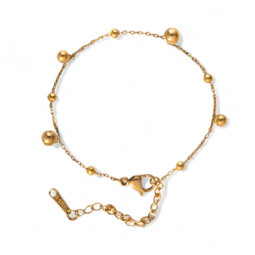
Gold Fine Chain Bead Bracelet 11138909
Fine gold-tone stainless steel chain bracelet dotted with polished beads of two sizes. Light and feminine.
Price €3.54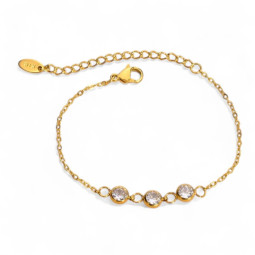
Gold Fine Three Rhinestone Bracelet 10201217
Fine gold-tone stainless steel chain bracelet with three bezel-set round rhinestones. Delicate and bright.
Price €5.04
Gold Small Ball Hoop Earrings 10969603-12
Small gold-tone stainless steel hoops made of large, tightly packed beads. A mini size full of relief.
Price €3.00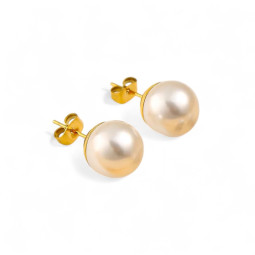
Gold Pearl Stud Earrings 11137538-2
Gold-tone stainless steel stud earrings set with a large round white pearl. Timeless, elegant and easy to wear.
Price €1.68
Gold Double Twisted Wire Ring 11324925-2
Slim open gold-tone stainless steel ring made of two parallel twisted bands, set slightly apart.
Price €2.52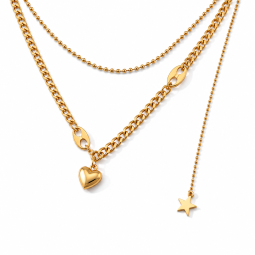

Gold-tone double-layer heart and star necklace 52305252
Two gold-tone chains, a smooth heart and a hanging star create this double-layer stainless steel necklace.
Price €5.28
Leave a comment