
Gold-tone stainless steel or gold-plated jewellery: which should you choose?
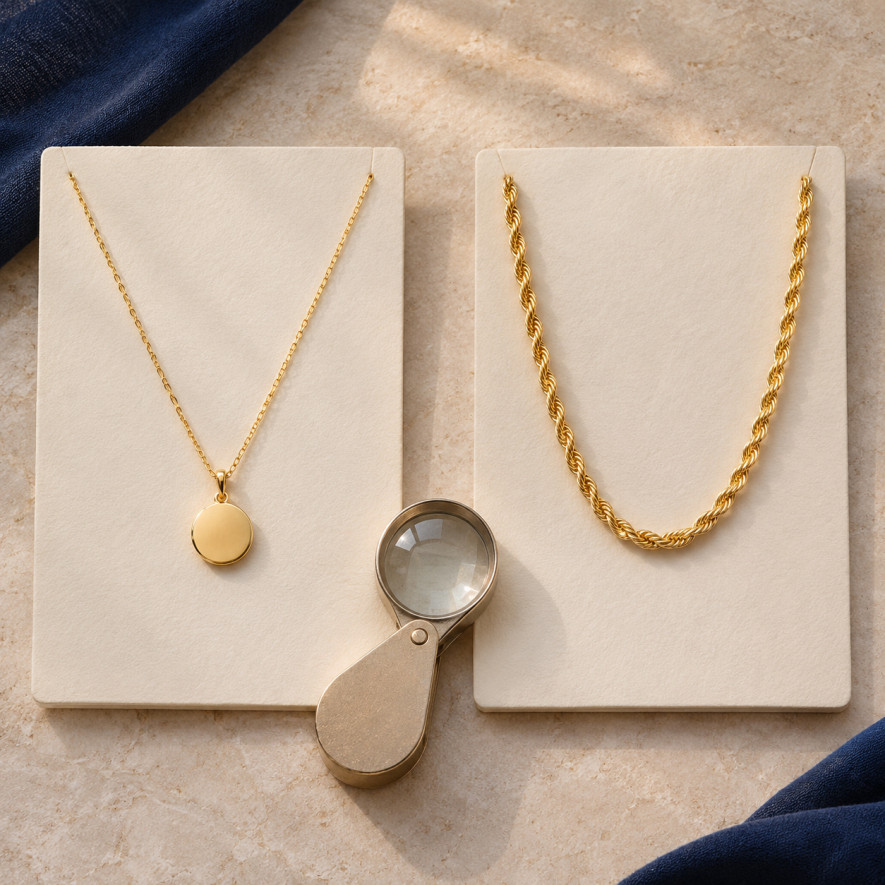
Separate base metal, finish and product description when comparing gold-tone stainless steel and gold-plated jewellery.
You compare two gold-coloured necklaces and their descriptions appear to discuss different things: stainless steel, gold plating, a gold-tone finish and sometimes PVD. The first useful step is to separate two questions: what is the piece made from, and how is its surface described? Stainless steel identifies a base material. Gold plating describes a coating with particular requirements. Those terms can therefore apply to the same piece rather than always representing two completely separate choices.
Your choice depends on your expectations, the available information and the way you wear jewellery. It is not simply a competition between one universally superior material and another that must be fragile. This guide explains useful terminology, offers a comparison method and shows how to read real examples from the Saze Diffusion catalogue. Products are described according to their listings; their appearance is never used to assign them gold plating that the specifications do not actually state.
Understand what stainless steel and gold plating describe
Stainless steel mainly identifies the base
Jewellery described as stainless steel can have a silver-tone appearance, a gold-tone finish or additional decorative elements. The principal material tells you about the base, rather than automatically explaining every surface treatment. Check whether the listing separates material from finish. This avoids a common misunderstanding: assuming that all gold-coloured pieces contain the same precious metal or must have received the same thickness of coating simply because they look similar in a photograph or beside each other.
Gold plating adds information about the surface
A gold-plated piece has a base covered with a gold layer. The material beneath that coating is still something to identify separately. In France, the description involves requirements concerning the coating; it does not rest on the visual impression of a gold-coloured object. Read the complete information instead of relying on a short commercial title. Two pieces can have a similar shade while differing in construction, decoration, attachment details and the care instructions appropriate to the finished design.
The two expressions are not always opposites
A stainless steel base can itself receive gold plating. Asking “stainless steel or gold-plated?” can therefore compare a material with a treatment that does not exclude it. Rephrase the question: what is the base, what finish is stated, and what information supports that description? This gives you a clearer basis for comparison. The same reasoning applies to a bracelet, ring or pair of earrings, whatever their style and however close their colours appear on screen.
Gold-tone, gold-plated and vermeil: read the terms carefully
A reference point for French terminology
The French DGCCRF explains the descriptions used for jewellery. In France, gold-plated terminology involves a 3-micron minimum and other conditions; vermeil combines a silver base with a gold layer meeting its own requirements. These are French naming rules. For a purchase in another country, check the applicable rules and description instead of automatically translating a commercial term as an equivalent guarantee. The title and the full specification should make sense together for the product concerned.
A gold-tone finish does not reveal the complete manufacturing process
In a listing, “gold-tone” may identify a colour or describe a finish. That word alone does not establish the exact process, treatment thickness or presence of gold meeting the requirements for gold plating. If a characteristic is missing, ask the seller for clarification. A warm shade, flattering photograph or evocative product name does not replace information about the actual construction. Keep what you can see and what is documented as two related but distinct parts of the decision.
PVD is not an automatic synonym for gold plating
Do not add the name of a process to a listing that does not state it. If a seller mentions PVD treatment, look for the details provided about that model rather than deducing the coating composition from those letters alone. Likewise, do not assign that treatment to every gold-tone stainless steel item. A useful comparison relies on documented characteristics, with consistent questions asked about both references instead of assumptions based on a general description of the material.
Compare pieces with a straightforward checklist
Start with the full product information
Open the detailed description and record what affects your decision: base, finish, measurements, fastening, decoration and care. Add what the offer contains, such as whether earrings are sold individually or as a pair. A short name can leave these details in another section. Where variants exist, make sure you are reading the information for the selected colour and size. Compare the pieces on that basis, rather than combining specifications belonging to several different options or photographs.
| Criterion | Stainless steel with a gold-tone finish | Jewellery described as gold-plated | Useful question |
|---|---|---|---|
| Base | Stainless steel stated | Base to identify | What material forms the foundation? |
| Surface | Finish depends on the listing | A gold layer is stated | What information documents the coating? |
| Colour | Gold-tone does not establish gold fineness | Shade depends on manufacture | Does the appearance suit my preferences? |
| Decoration | Read separately from the base | Read separately from the plating | What is it made from and how is it cared for? |
| Use | Depends on construction | Depends on construction | What precautions are recommended? |
| Complete price | Check the basket | Check the basket | What does the purchase actually include? |
Do not treat price as a composition test
Price can reflect many things: materials, manufacturing work, distribution, design or associated services. It does not prove a process or coating thickness on its own. A higher amount does not remove the need for clear specifications, and an accessible price is not a diagnosis of the piece. Compare what is stated with what you are looking for, then check the complete order cost rather than an isolated number shown in an advertisement or a promotional photograph.
Separate the appearance you want from the property you require
You may want a gold colour because it works with your clothes, without specifically seeking a gold coating. Alternatively, the documented presence of a precious metal may be important to you. Both approaches are valid, but they require different information. Write down your priority before choosing: appearance, material, dimensions or a gift that you can describe precisely. Comparison becomes quicker once your main criterion is explicit and you can distinguish an aesthetic preference from a requirement about composition.
Choose according to how you wear jewellery
For a piece worn regularly
Think about what your day actually involves. Does a bracelet touch a table or watch? Does a ring accompany frequent handling tasks? Does your necklace rub against fastenings or textured fabric? Those contacts matter for surfaces and attachments whatever the piece is called. Choose construction compatible with your habits and take the item off when an activity could expose it to unsuitable pulling or products. A familiar everyday routine is more informative than a general claim about wearing jewellery everywhere.
For a gift you can describe accurately
When giving jewellery, use the exact terms from its description. Gold-tone stainless steel should not become a gift presented as “gold” simply because it has a warm appearance. Accuracy does not diminish the thought behind it. Explain why you chose the shape, motif or dimensions, and keep the useful information for the recipient. A thoughtful gift suits their preferences and everyday use without requiring you to add an unsupported material or special property to its story.
For a first personal selection
Someone discovering their preferences can begin with a category they already enjoy wearing and a shape that is easy to combine with familiar clothes. The aim is to assess enjoyment before expanding a collection. Browse the Saze Diffusion jewellery catalogue and compare a small number of references. Our guide to choosing gold-tone or silver-tone jewellery for your style can support that reflection: aesthetic preference and a documented material description remain two distinct parts of a well-informed choice.
For someone with known sensitivities
Do not infer individual suitability from “steel”, “gold” or “plated” alone. A known sensitivity calls for information appropriate to the person and, where necessary, advice from a healthcare professional. This comparison explains purchasing terminology; it cannot select a medically suitable material for everyone. If wearing a piece causes discomfort or a reaction, stop wearing it and seek appropriate advice instead of trying to change its surface with a household product or treating a product category as a personal guarantee.
Six Saze Diffusion examples: what the listing allows you to say
A drop necklace that separates finish from decoration
The gold-tone pearlescent drop necklace 50980723 is described as stainless steel with a gold-tone finish and white pearlescent-looking decoration. Its length is 39 cm with a 5 cm extension. That information lets you describe the colour, base and measurements. It does not establish gold plating, natural mother-of-pearl or an unstated manufacturing process. Keep those limits when comparing it with another piece, writing a gift description or deciding which care instructions apply to the decorative element.
A clover necklace that explains silver-tone wording
The silver-tone white clover necklace 33537003 demonstrates the same approach in another colour. Its stated base is stainless steel with a silver-tone finish; the chain measures 39 cm with a 5 cm extension. Here “silver-tone” identifies the stated finish without turning the piece into sterling silver. White sections form a decoration whose appearance should not be used to invent a precious material. Colour, base and decorative effect can all be appreciated while remaining accurately described.
An open ring that highlights construction too
The double twisted-wire ring 11324925-2 features two textured lines in gold-tone stainless steel. Its open band is described as adjustable, which does not mean universal sizing. This detail may matter as much to your decision as the colour. Do not compare rings only by their base material: consider shape, known adjustment limits and how you can wear them. Avoid forcing an opening to match an assumed measurement or repeatedly bending the band as a routine sizing method.
A fine bracelet whose fit needs checking
The fine gold-tone bead bracelet 11138909 measures 16 cm and has a 5 cm extension. Its listing describes a chain with differently sized beads and a lobster clasp. Record those dimensions and compare them with a comfortable bracelet you already wear. Choosing a gold-coloured appearance does not resolve sizing: unsuitable length remains unsuitable even when the principal material matches your preference exactly. Read the base length and extension together, and consider your preferred room for movement rather than the maximum length alone.
A rhinestone bracelet that separates metal from sparkle
The fine three-rhinestone bracelet 10201217 combines a gold-tone stainless steel chain with three sparkling decorations. The stated measurements are 17 cm and a 5 cm extension. Those rhinestones should not be described as diamonds. The design illustrates how several visual elements can sit beneath one short product name: check each feature that matters to you rather than expecting the principal material to explain everything, including decoration, fastening, measurements and suitability for a particular kind of daily use.
A double-layer necklace whose dimensions shape the choice
The double-layer heart and star necklace 52305252 combines 40 and 45 cm layers with a 5 cm extension. The chains close together, and a small star drop completes the design. These details let you compare an assembled layered effect with a single-chain necklace. The listing does not describe two independent necklaces or prove gold plating. Careful reading avoids expectations about contents or materials that differ from the actual offer, even where the overall photograph looks similar to another style.
Care for the piece according to its characteristics
Protect the finish and attachments
Follow the model's instructions and avoid aggressive rubbing. A treatment suitable for bare metal may not suit a decorative surface or an added element. Keep a clean cloth, store pieces separately and remove them before activities that could catch them. Our stainless steel jewellery care guide covers general habits to compare with the product information. It does not replace a specific answer about a particular decoration, attachment or treatment whose composition is not explained in the available description.
Ask when an important detail is missing
If the finishing process is essential to your choice, ask the seller before ordering. Give the reference and a concrete question, such as the nature of the base or how the coating is described. A documented response lets you decide according to your own priorities. Do not try to confirm plating by scratching a hidden area or performing an improvised experiment. Such tests can damage a piece without providing a reliable conclusion about its composition or the requirements behind its commercial description.
Frequently asked questions about gold-tone steel and gold plating
Does gold-tone stainless steel always contain gold?
Colour wording alone does not establish that. Read the treatment description and ask for clarification if gold content matters to your choice. The same caution applies to a picture: a golden reflection does not reveal composition or thickness. Always describe the piece using the characteristics documented for the actual reference, rather than a general assumption about how similar-looking jewellery is usually made.
Can jewellery be stainless steel and gold-plated?
Yes, the expressions do not necessarily identify mutually exclusive categories. One can describe the base and the other its surface. However, the description must be justified under the applicable rules. Check the complete information rather than adding “gold-plated” yourself to a product that is described only as stainless steel with a gold-tone finish or a gold-coloured appearance.
Which choice is more durable?
There is no universal answer based on those words alone. Construction, the documented coating and conditions of use affect the comparison. Read the manufacturer's care information and precautions. No name allows you to promise that a piece will keep the same appearance indefinitely in every situation or under repeated friction. Assess the specific design and the activities for which you intend to wear it.
Is gold-plated jewellery the same as solid gold?
No. Plating describes a coating over a base; solid gold is a different material description with fineness stated according to applicable rules. Do not substitute one expression for the other when buying or giving a gift. If composition is decisive, ask for the necessary specifications instead of relying on colour, a photograph or an informal description that does not identify the actual material.
How do I choose if I simply want gold-coloured jewellery?
Start with a style you like, suitable dimensions and your complete budget. Then check the stated material and care compatible with your intended use. You do not have to attribute a precious metal to a piece to appreciate its shape. Clear information helps you choose what the design actually offers, with expectations consistent with its description, construction and your own everyday habits.
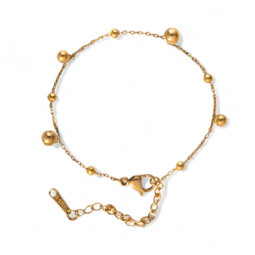
Gold Fine Chain Bead Bracelet 11138909
Fine gold-tone stainless steel chain bracelet dotted with polished beads of two sizes. Light and feminine.
Price €3.54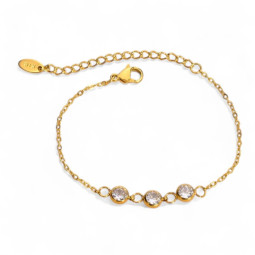
Gold Fine Three Rhinestone Bracelet 10201217
Fine gold-tone stainless steel chain bracelet with three bezel-set round rhinestones. Delicate and bright.
Price €5.04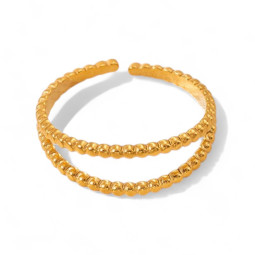
Gold Double Twisted Wire Ring 11324925-2
Slim open gold-tone stainless steel ring made of two parallel twisted bands, set slightly apart.
Price €2.52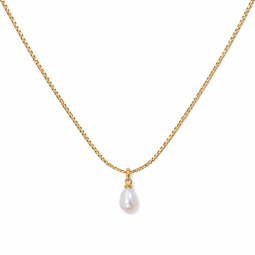
Gold-tone necklace with a pearlescent drop pendant 50980723
A small white pearlescent-look drop finishes this fine gold-tone stainless steel necklace with a lobster clasp and extension chain.
Price €4.68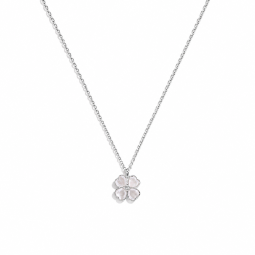
Silver-tone necklace with white four-leaf clover 33537003
Four white heart-shaped petals form a silver-tone edged clover on this fine stainless steel necklace, adjustable with an extension chain.
Price €3.84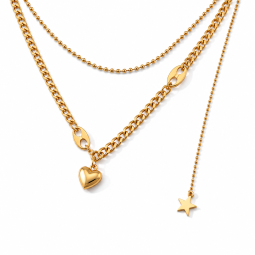

Gold-tone double-layer heart and star necklace 52305252
Two gold-tone chains, a smooth heart and a hanging star create this double-layer stainless steel necklace.
Price €5.28
Leave a comment